May 5, 2025

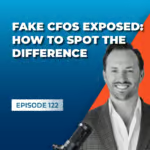
Chris May – Fake CFOs Exposed: How to Spot the Difference

This week James sits down with Chris May, founder and CEO of Quadrant Advisory, to explore what separates real CFO strategy from everyday accounting. From turning around a $50M political consulting firm to navigating tricky incumbent finance teams, Chris shares practical advice for business leaders and fractional CFOs alike. Together, they unpack key finance tools like sensitivity analysis, working capital management, and how to tell whether your books are just “done” – or actually useful. Chris also walks us through his own acquisition of a bookkeeping SaaS and what it taught him about keeping services laser-focused.
The Gross Profit Podcast
Chris May - Fake CFOs Exposed: How to Spot the Difference
Loading
/

Show Notes

In this episode James Kennedy sits down with Chris May, founder and CEO of Quadrant Advisory, to explore what separates real CFO strategy from everyday accounting. From turning around a $50M political consulting firm to navigating tricky incumbent finance teams, Chris shares practical advice for business leaders and fractional CFOs alike.

Together, they unpack key finance tools like sensitivity analysis, working capital management, and how to tell whether your books are just “done” – or actually useful. Chris also walks us through his own acquisition of a bookkeeping SaaS and what it taught him about keeping services laser-focused.

Stick around to hear how Chris defines a great CFO – and why Naval Ravikant is his go-to business hero.

About Chris May:
Chris May is the founder and CEO of Quadrant Advisory, a U.S.-based fractional CFO and outsourced accounting firm serving growth-stage companies between $5M–$50M in revenue. With roots in Washington, D.C., Chris and his team specialize in professionalizing finance functions, uncovering strategic insights, and stepping in when founders realize they’ve outgrown their bookkeeping setup.

He’s also the co-owner of Less Accounting, a bookkeeping SaaS and service firm focused on simplifying accounting for early-stage entrepreneurs.

What You’ll Learn:

  • Accounting vs. CFO Thinking: What makes a great fractional CFO – and how to avoid paying for “strategy” that’s really just back-office clean-up.
  •  Working Capital Mastery: How Chris helped one client free up $5M (yes, five million) by cleaning up their accounting and resetting the foundation.
  • Sensitivity Analysis Simplified: What it is, why it matters, and how the best CFOs use it to shape better business decisions.
  • Acquisition Lessons from the Trenches: Why Chris bought a small SaaS bookkeeping firm – and what worked (and didn’t) from the deal.

Episode Highlights:

  • “If you’re not learning something new from your CFO every quarter, that’s a red flag.”
  • “A real CFO helps you make decisions. It’s not just about clean books – it’s about actionable insights.”
  • “Sometimes, the job is part-detective, part-diplomat. Especially when there’s an incumbent team and messy numbers.”
  • “We paid 4x for the software side and 1x for services. Blended together, it was a fair deal – but the synergy is still a work in progress.”

More about Chris’s Role:
As CEO of Quadrant Advisory, Chris leads a team of nearly 30 remote finance professionals who act as fractional CFOs, controllers, and accounting experts for growth-stage businesses across the U.S.

Whether it’s untangling legacy bookkeeping, advising boards, or helping companies get acquisition-ready, Quadrant focuses on building scalable financial infrastructure. Chris is also a passionate advocate of clear, jargon-free finance communication – and believes that the best CFOs can explain complex models to a five-year-old.

The Gross Profit Podcast

More Episodes

Merushka Chetty

Elliott Gaspar – UK’s Secret Weapon Against Silicon Valley

In this episode, James Kennedy sits down with Elliott Gaspar, UK-based Fractional CFO and founder of a fast-growing finance practice, to unpack how the UK’s unique tax-advantaged investment schemes (SEIS/EIS) can accelerate early-stage growth – and how easily founders can lose their eligibility without realizing it.

Drawing on a career that started in Oxford University finance, scaled through private-equity-backed energy infrastructure, and evolved into advising high-growth, asset-heavy startups, Elliott explains why CFOs must be storytellers, how to build investor-ready financial models, and why UK entrepreneurs still underestimate the power of compliance-driven incentives.

They also explore:
– Why the UK remains one of the world’s best places to raise capital
– How founders accidentally invalidate SEIS/EIS (and how to avoid it)
– When asset-heavy roll-ups can unlock better financing
– The role of the Fractional CFO community in raising standards

Listen Now »
Merushka Chetty

Chris Gwinn – CFO Adds $1M EBITDA Without Timesheets

In this episode, James Kennedy sits down with Chris Gwinn, CFA and founder of Midwest CFO, to unpack how a fractional CFO helped a $7.5M digital agency boost gross margins from 26% to 48% and add $1M in EBITDA – without forcing creatives into traditional timesheets. Chris shares why he exited a successful process-improvement consultancy to build a more recurring, finance-driven practice, how he uses podcasts as a growth engine, and the simple pricing and cost-allocation shifts any B2B services firm can use to increase valuation.

Listen Now »
Merushka Chetty

Carolina Aponte – Venezuelan Immigrant’s Rise to Top CFO Success

In this episode, James Kennedy sits down with Carolina Aponte – fractional CFO, founder, and co-host of the Breaking Even Better podcast – to trace her journey from teen tour guide in Venezuela to award-winning North Carolina business owner. Carolina shares how she arrived in the U.S. at 20 without a high school diploma, juggled three jobs to survive, and used night classes plus on-the-job learning to climb from receptionist to controller and ultimately firm owner.

They unpack what a great controller actually does, how finance leaders can influence (but not control!) CEOs, and why relationships, resilience, and “improv” are just as important as debits and credits. Carolina also talks about helping more than 10 clients break the $1M revenue barrier and how her team-based model delivers 90%+ client retention.

Listen Now »